
-
-
Products

-
Quality and Service

-
Investor Relations

-
-
Career Development

-


Natural-gas heavy-duty trucks sold 9,592 units in February, up 49%—FAW maintained its top spot, while Sinotruk surged 266%, and BAIC/Kaiwo cracked the top ten.
Release Date:
2024-03-19
After setting an all-time sales record of 152,000 units in 2023, China’s natural-gas heavy-duty truck market was widely forecast to remain robust in 2024. And indeed, in January 2024, the segment delivered a strong start, posting a year-on-year growth of 96%—nearly doubling its sales.
In February, the heavy-truck market remained sluggish, and with the added impact of the Spring Festival holiday, total retail sales fell short of 30,000 units, marking declines on both a month-over-month and year-over-year basis. Can the natural-gas-powered heavy-truck segment sustain its growth? Read the analysis report from First Commercial Vehicle Network.
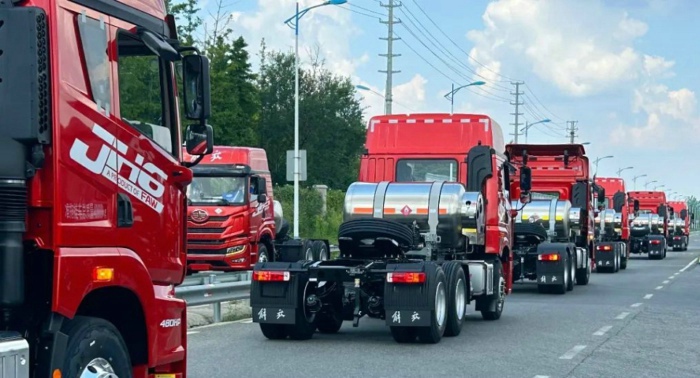
In February, sales reached 9,592 vehicles, up 49% year over year, marking the 15th consecutive month of growth.
According to end‑user sales data compiled by the First Commercial Vehicle Network—based on compulsory traffic insurance records and excluding exports and military‑grade vehicles—domestic natural‑gas heavy trucks recorded 9,592 units sold in February 2024, up 51% month over month compared with January and continuing to grow year over year, with a 49% increase. The year‑on‑year growth rate has moderated from last month’s 96%, but the overall upward trend remains robust. With this result, the current rally in the natural‑gas heavy‑truck market, which began in December 2022, has now extended to a 15‑month streak of consecutive growth.

As shown by the monthly trend chart of domestic natural‑gas‑powered heavy‑truck sales over the past five years, initial sales in January have generally been modest, hovering around 5,000 units. In February, with the notable exception of 2020—when the pandemic severely disrupted the market—sales typically exhibit a clear month‑over‑month rebound compared to January. Notably, both January and February this year see sales levels significantly higher than in previous years; the red line for 2024 marks the highest point in the five‑year period, with January and February of this year posting the best results in five years. In fact, the domestic heavy‑truck market had already cooled markedly at the end of 2023, and terminal demand continued to decelerate further into 2024, with actual sales falling to just 33,900 units in January and 26,500 units in February. Against a backdrop of a cooling market and constrained overall demand, the natural‑gas‑powered heavy‑truck segment has nonetheless maintained robust growth, underscoring that this recent boom is not merely speculative.

Although demand remains sluggish, another major factor influencing the natural‑gas‑powered heavy‑truck market—natural‑gas prices—has been trending increasingly favorably in 2024. In December 2023, the average LNG price hovered around RMB 6,000 per ton, significantly eroding the cost‑effectiveness of natural‑gas‑powered heavy trucks by year’s end. By January 2024, prices had edged down to roughly RMB 5,300 per ton, and in February, wholesale LNG prices continued to fall, with the average price dipping below RMB 4,400 per ton (as shown in the chart), returning to levels last seen in September of the previous year. This price correction has provided a modest boost to buyers’ willingness to invest in gas‑powered heavy trucks. Despite overall weak demand and the impact of the Spring Festival holiday, the natural‑gas‑powered heavy‑truck market still posted a month‑over‑month growth of 51% in February, underscoring the price‑driven stimulus effect on this segment.

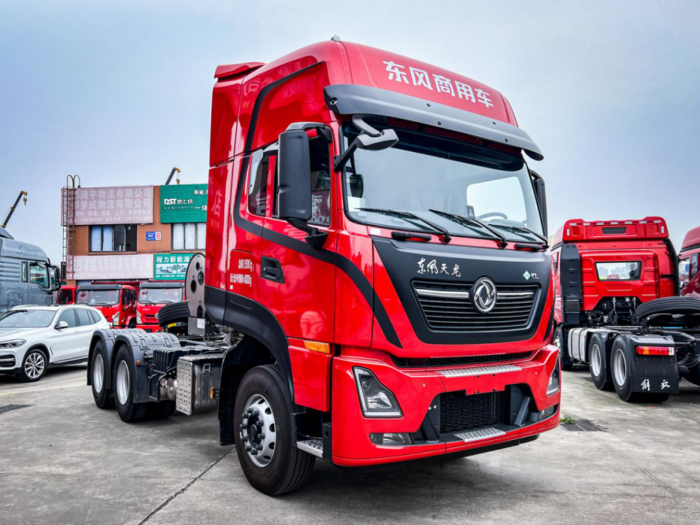
From the perspective of end‑user sales regions, during January–February 2024, a total of 30 provinces, municipalities, and autonomous regions nationwide registered natural‑gas‑powered heavy trucks for on‑road use (compared with 26 regions in the same period last year). Regional distribution remains highly uneven: resource‑rich logistics hubs such as Hebei, Shanxi, Henan, and Shandong accounted for the majority of end‑user sales in the first two months of this year (as shown in the chart below). In January–February, Hebei and Shanxi ranked first and second, with shares of 22.9% and 19.2%, respectively; during this period, 3,658 and 3,060 natural‑gas heavy trucks were registered in these two provinces, respectively. Henan, Shandong, Ningxia, and Sichuan followed in ranks 3 through 6, with 1,334, 1,272, 890, and 752 registrations, representing 8.4%, 8.0%, 5.6%, and 4.7% of the total, respectively. Meanwhile, Xinjiang and Inner Mongolia, ranking seventh and eighth in regional registration volumes, each recorded more than 600 new registrations in January–February, accounting for 4.4% and 3.8%, respectively.
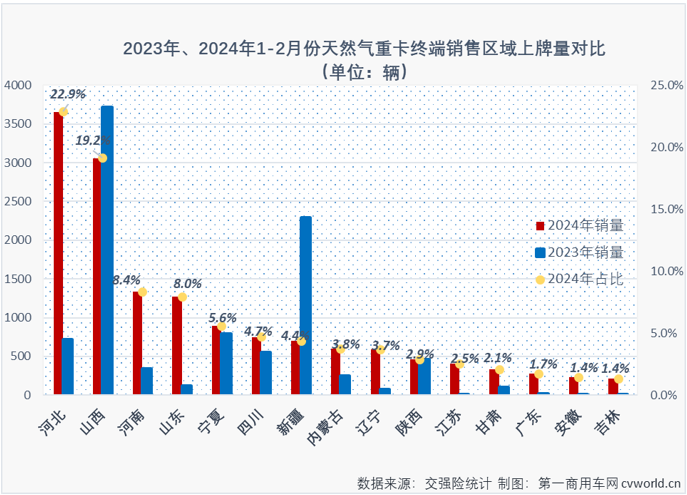 (Note: Others include Chongqing, Tianjin, Heilongjiang, Guizhou, and other provinces, autonomous regions, and municipalities.)
As shown in the chart, not all provinces saw year-on-year growth in natural‑gas heavy‑truck registrations during January–February this year; in Shanxi, Xinjiang, Shaanxi, and other regions, registration volumes declined. Of the more than 6,000 additional natural‑gas heavy trucks registered in January–February 2024, the bulk of the increase was concentrated in Hebei, Henan, Shandong, Liaoning, and other areas. Hebei alone accounted for nearly 2,000 of these new registrations, while Shandong and Henan each added around 1,000 vehicles. In terms of growth rates, many provinces—including Hebei, Henan, Shandong, Inner Mongolia, Liaoning, Jiangsu, Gansu, and Guangdong—outpaced the overall market’s expansion during the same period. Specifically, Hebei, Henan, Shandong, Inner Mongolia, Liaoning, and Jiangsu recorded year‑on‑year increases of 411%, 297%, 934%, 144%, 655%, and 4,411%, respectively.
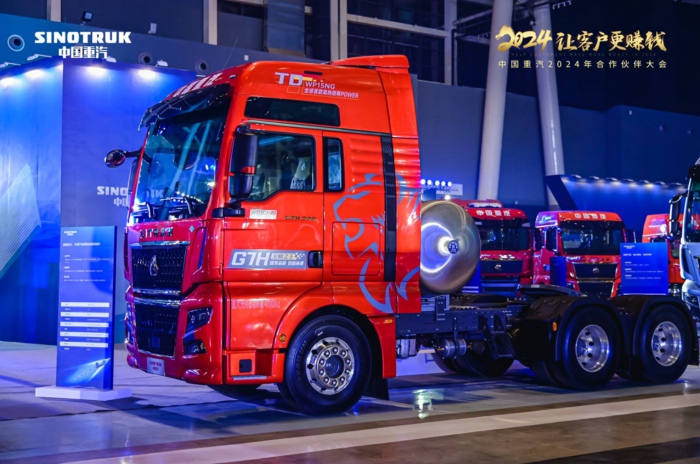
Four companies each sold over 1,000 units, with Jiefang topping the sales charts for the second consecutive month, delivering more than 3,000 vehicles.
In February 2024, domestic sales of natural-gas-powered heavy-duty trucks reached 9,592 units, up 49% year over year. This growth rate narrowed by 47 percentage points compared to the previous month (January, when year-over-year growth stood at 96%), and represented an increase of roughly 3,100 units over February 2023—about 1.5 times the level of that month.

First Commercial Vehicle Network noted that in December 2023 and January 2024, only three and two companies, respectively, recorded sales exceeding 1,000 natural‑gas heavy trucks. By February 2024, that number had risen to four. In February, Jiefang, Sinotruk, Shaanxi Auto, and Dongfeng each sold more than 1,000 units; among them, Jiefang led the pack with 3,454 vehicles, capturing a 36.01% market share and securing its second consecutive monthly title as the top seller in the natural‑gas heavy‑truck segment.

February 2024 Domestic Natural Gas Heavy-Truck Terminal Sales Ranking (Unit: vehicles)
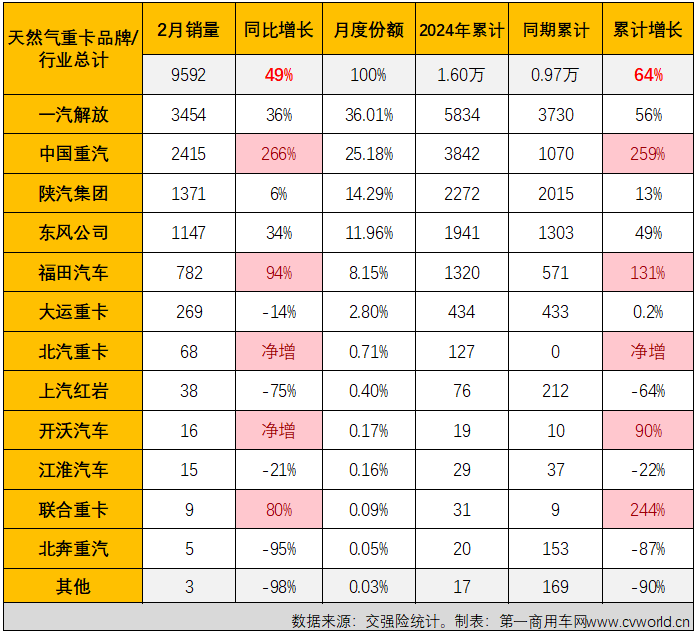
As shown in the table above, in February 2024, the natural‑gas heavy‑truck market grew 49% year over year. However, among heavy‑truck manufacturers, performance was far from uniform: of the top ten companies, seven posted gains while three saw declines; expanding the scope to the top twelve, one additional manufacturer reported a drop. In February, China National Heavy Duty Truck Group, Foton, and United Truck recorded year‑over‑year sales increases of 266%, 94%, and 80%, respectively—outpacing the overall growth of the natural‑gas heavy‑truck segment. Meanwhile, BAIC Heavy‑Duty Truck and Kaiwo Motors, which had zero sales in February last year, posted net growth. Conversely, the few companies reporting declines all experienced double‑digit drops, with the worst performer seeing a 95% year‑over‑year plunge in sales.

In terms of market share, in February four manufacturers each held more than 10% of the natural-gas heavy-truck market. The top two—FAW and Sinotruk—each posted monthly shares exceeding 20%, with FAW and Sinotruk selling 3,454 and 2,415 natural-gas heavy trucks, respectively, for monthly shares of 36.01% and 25.18%. Shaanxi Auto and Dongfeng sold 1,371 and 1,147 natural-gas heavy trucks, respectively, accounting for 14.29% and 11.96% of the market. Foton and Dayun captured 8.15% and 2.8% of the market, respectively, with sales of 782 and 269 units. Meanwhile, all other manufacturers recorded sales below 100 units, each holding less than 1% of the market.
Compared with January 2024, February saw significant changes in both the top‑ten players and their rankings in the natural‑gas heavy‑truck market: the top eight remained unchanged, while Kaiwo Auto climbed five spots from 14th in January to 9th in February, and JAC moved up one place from 11th to break into the top ten. Conversely, the two companies that ranked 9th and 10th in January were both pushed out of the top ten in February.
Cumulative sales for January–February reached 16,000 units, up 64%, with Sinotruk and Foton posting significant gains in market share.
In January–February 2024, cumulative sales of natural-gas‑powered heavy-duty trucks in China reached 16,000 units, up 64% year on year. The growth rate of cumulative sales narrowed by 32 percentage points compared with the figure recorded after January (+96%), and sales were more than 6,200 units higher than in the same period of 2023. Looking at individual players, market‑leading manufacturers posted mixed results: most companies reported rising cumulative sales, with Sinotruk, Foton, and United Heavy Trucks posting year‑to‑date growth rates exceeding the overall market’s 64%, outpacing the sector as a whole. Leading natural‑gas truck brands such as Jiefang, Shaanxi Auto, and Dongfeng also delivered double-digit growth.
Top 10 Rankings of Natural Gas Heavy-Truck Terminal Sales for January–February 2024 (Unit: vehicles)

After February 2024, five companies in the natural-gas heavy-truck market have each recorded cumulative sales exceeding 1,000 units. Leading the pack, Jiefang has accumulated 5,834 units, capturing a market share of 36.55%; China National Heavy Duty Truck Group has sold 3,842 units, with a market share of 24.07%. Shaanxi Automobile, Dongfeng, and Foton reported cumulative sales of 2,272, 1,941, and 1,320 units, respectively, for January–February, corresponding to market shares of 14.23%, 12.16%, and 8.27%. Daima, ranked sixth in cumulative sales, delivered 434 natural-gas heavy trucks in the first two months of this year, accounting for a 2.72% market share. The remaining manufacturers all hold market shares below 1%.
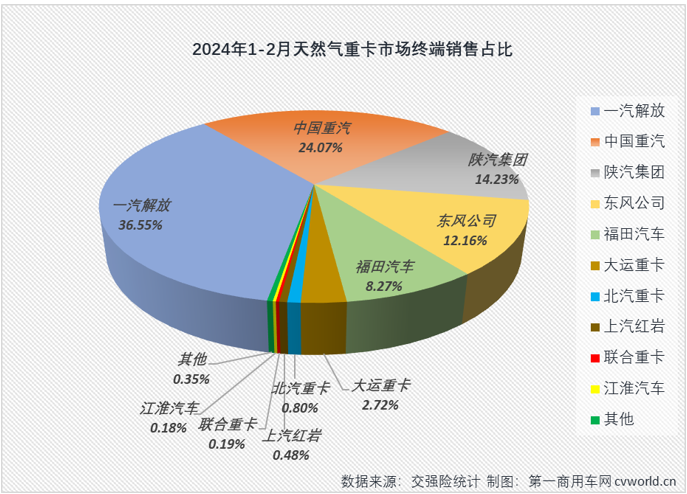
Compared with the same period in 2023, four of the top ten companies in sales saw their market shares increase in January–February this year. The most significant gain was recorded by China National Heavy Duty Truck Group, whose market share rose sharply by 13.05 percentage points year over year. Foton’s share increased by 2.39 percentage points, while Beiqi Heavy‑Duty Trucks and United Heavy‑Duty Trucks also posted modest gains. Among these companies, cumulative sales growth has outpaced the overall 64% expansion of the natural‑gas heavy‑truck market (with Beiqi Heavy‑Duty Trucks posting net growth).

First Commercial Vehicle Network has observed that, compared with last year’s year-end rankings, the landscape of the natural‑gas heavy‑truck market in January–February this year has shifted significantly. The top six players—FAW, Sinotruk, Shaanxi Auto, Dongfeng, Foton, and Dayun—have held onto their respective year‑end positions from last year. Changes have emerged among the lower‑ranked companies: Beiqi Heavy Truck has climbed 10 spots from last year’s 17th place to now occupy 7th; United Heavy Trucks has moved up one spot to 9th; and JAC has advanced two places to 10th. Meanwhile, several firms have slipped in the rankings compared with year‑end last year, with two even falling out of the top ten. It should be noted, however, that in the first two months of 2024, sales of natural‑gas heavy trucks remained modest across the board, with many companies posting cumulative volumes in the double digits. With relatively small gaps between adjacent competitors, each player has had multiple opportunities to close the gap.
Conclusion
In the first two months of this year, sales of natural-gas‑powered heavy trucks continued to grow, with robust growth rates that have extended the streak to 15 consecutive months, making them one of the few bright spots in today’s sluggish heavy‑truck market. As of March 13, LNG wholesale prices remained around RMB 4,200 per ton—roughly equivalent to levels seen in September last year, a relatively favorable pricing environment. Meanwhile, with the heavy‑truck industry poised to enter its traditional peak sales season, these favorable factors suggest that the year‑on‑year growth trend in the natural‑gas heavy‑truck segment is highly likely to extend beyond its current 15‑month run.
Related Information

 2025-12-05


Dedicated to the manufacturing, sales, and technological innovation of on‑board LNG fueling systems.
Contact Us
Address: Chaoyang Economic Development Zone, Changchun City, Jilin Province
No. 888 Yumin Road
Email:zhiyuanzhuangbei@163.com
Contact phone number:0431-85011202
After-sales phone
- All
- Product Management
- News and Information
- Introduction Content
- Corporate outlets
- Frequently Asked Questions
- Corporate Video
- Corporate Portfolio
© 2021 Changchun Zhiyuan New Energy Equipment Co., Ltd.